5 sections of this entry are open to everyone: the summary, the people, the symbols, the lineage and the sources. The other 9 (Name and epithets, In the ancient sources, The myths, Worship and archaeology, How the god was depicted, What scholars debate, After antiquity, Did you know?, Codex relic) are part of the full Codex: PRO opens the whole study of all 500 deities, and without a subscription you can read one full entry a day, just like in the app.
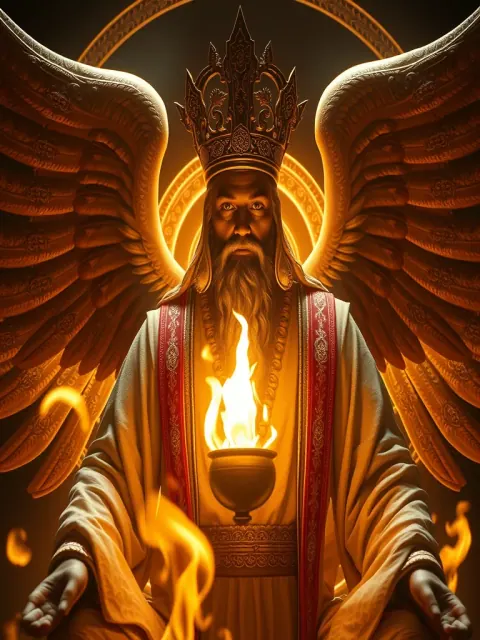
The Persian deities belong to Zoroastrianism, the faith of the ancient Persian Empire, founded on the teachings of Zarathustra. Centered on the cosmic struggle between good (Ahura Mazda) and evil (Angra Mainyu), it influenced Judaism, Christianity, and Islam. It is still practiced by Zoroastrian communities in Iran and India (the Parsis).
In the fire temples, priests keep sacred flames that have burned for centuries — the one in Yazd, Iran, for over 1,500 years. Nowruz, the Persian new year at the spring equinox, and Yalda night, at the winter solstice, celebrate the victory of light over darkness.
01
At a glance
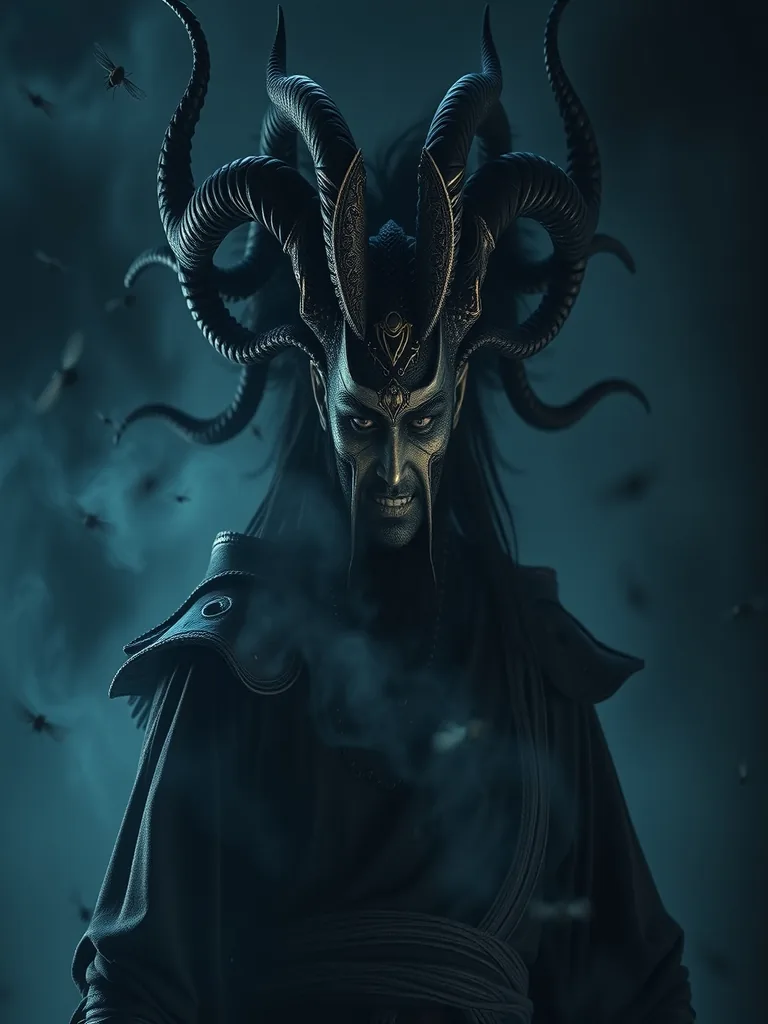
Angra Mainyu (Avestan: Aŋra Mainyu; Middle Persian: Ahreman or Ahriman) is the cosmic principle of evil, the Destructive Spirit, and the absolute antagonist of Ahura Mazda and Spenta Mainyu in Zoroastrian theology. Unlike pagan storm deities or chthonic underworld gods, Angra Mainyu is not a legitimate deity nor an object of human worship; venerating his demonic hordes (the daevas) is considered the gravest moral sin of spiritual corruption in Mazdaean tradition. In the Gathic hymns composed by Zarathustra, Angra Mainyu emerges as a primordial spirit who, endowed with free will, deliberately chose 'non-life', the Lie (Druj), and base thoughts, in absolute opposition to Spenta Mainyu, who chose truth (Asha) and the creation of life. As declared in Yasna 45.2, nothing between these two spirits can ever align: neither thoughts, teachings, choices, words, deeds, consciences, nor souls. Lacking the power of genuine creation (dadvah), Angra Mainyu functions ontologically as a parasitic corrupter: his entire activity consists of counter-creation (paityāra), introducing death, disease, pests, bitter frost, venomous vermin (khrafstar), and moral discord into the pristine material realm (getig) fashioned by Ahura Mazda. Zoroastrian eschatology promises his final annihilation or eternal paralysis in outer darkness at the end of time (Frashokereti).
7 min read · Reviewed on September 30, 2026 · How we research
02
Sacred symbols
The serpent, the darkness, the lie (druj) and the daevas
03
Family
Siblings
Spenta Mainyu (the holy twin spirit choosing cosmic integrity in Yasna 30.3; in Zurvanism, Ohrmazd is his brother)
Angra Mainyu
Unions
Jeh or Jahi (the primeval demoness of pollution and lust who revives Ahriman from his stupor in the Bundahishn)
Children
Aka Manah / Akoman (Evil Mind, the direct antithesis of Vohu Manah)Indra / Indar (the arch-demon who misleads mankind and freezes moral virtue)Saurva / Sovar (the arch-demon of tyranny, anarchy, and political oppression)Naonghaithya / Taromati (arrogance and heresy, arch-foe of Spenta Armaiti)Taurvi and Zairicha / Tirev and Zairik (arch-demons of fever, decay, and poisons, opposed to Haurvatat and Ameretat)Aeshma / Kheshm (the arch-demon of bloody wrath, violence, and reckless frenzy)Azi Dahaka / Zahhak (the three-headed serpentine monster spawned by Ahriman to afflict the earth)
Genealogy according to Avesta (Gathas: Yasna 30.3–6, 45.2; Videvdad 1, 19, 22); Textos Pálavi (Bundahishn 1, 3, 27, 34; Denkard 3, 5; Seleções de Zadspram); Jacques Duchesne-Guillemin (1958, 1982); Mary Boyce (1975); R. C. Zaehner (1961)
04
Sources and further reading
Primary sources
Zarathushtra (attributed) & Mills, Lawrence H., The Gathas: Ushtavaiti and Spenta-Mainyu Hymns (Yasna 43–50). translation: Classic translation of the hymns of ethical choice in the Sacred Books of the East. read
Darmesteter, James, The Zend-Avesta: The Vendidad (Fargards I and XIX: On Counter-Creations and Temptation). translation: Annotated English digital version of the Avestan purity code. read
Avesta.org Digital Archive, Vendidad: Fargard 1 (Sixteen Lands and Demonic Afflictions). translation: Transcription and translation of the first geographic chapter of the Videvdad. read
West, Edward William, Pahlavi Texts, Part I: Bundahishn (Chapters I–III: The Assault of the Evil Spirit). translation: Translated edition of the Pahlavi cosmogonic codex at the Sacred Texts Archive. read
Avesta.org Digital Archive, Bundahishn: Chapter 3 (On the Rush of the Destroyer upon the Creations). translation: Digitized text on the bodily invasion by Ahriman. read
Haug, Martin & West, E. W., The Book of Arda Viraf (Chapters LIII–C: The Vision of Hell). translation: Diplomatic translation of the Zoroastrian visionary journey to the underworld. read
Plutarch & Babbitt, Frank Cole, Moralia: De Iside et Osiride (Sections 46–47 on Persian Dualism). translation: Bilingual Greek-English edition of the Plutarchan treatise. read
Studies
Duchesne-Guillemin, Jacques, AHRIMAN. Encyclopaedia Iranica, Vol. I, Fasc. 7, pp. 670–673, 1984. open
Boyce, Mary, A History of Zoroastrianism: The Early Period (Vol. I, Ch. 7–9 on Dualism). E.J. Brill Academic Publishers, Leiden / Cologne, 1975. open
Zaehner, Richard Charles, The Dawn and Twilight of Zoroastrianism. Weidenfeld and Nicolson, London, 1961. open
Zaehner, Richard Charles, Zurvan, a Zoroastrian Dilemma. Clarendon Press, Oxford, 1955. open
Shaked, Shaul, Dualism in Transformation: Varieties of Religion in Sasanian Iran. School of Oriental and African Studies (SOAS), London, 1994. open
Wikipedia, Ahriman. Wikimedia Foundation, 2024. open
Name and epithets
The Avestan compound name Angra Mainyu consists of two elements with precise theological and grammatical significance.
In the ancient sources
Avesta (Gathas: Yasna 30 and 45), c. 1200–1000 BC (oral liturgical transmission). Primary foundational hymns in which Zarathustra articulates cosmic dualism between Spenta Mainyu and Angra Mainyu.
The myths
The Primordial Choice and Total Discordance (Yasna 45.2). In the verses of Yasna 45.2, the prophet Zarathustra proclaims the uncompromising basis of Zoroastrian cosmic dualism.
Worship and archaeology
In strict contrast to Ahura Mazda, Angra Mainyu was never honored with positive worship or sacrificial offerings in Zoroastrian religion.
How the god was depicted
Achaemenid art did not depict Angra Mainyu directly by name, choosing instead to symbolize the royal triumph over chaotic darkness through palace reliefs at Persepolis, where the Great King is shown thrusting a dagger i…
What scholars debate
Primordial Autonomy versus the Fallen Aspect Controversy. Scholars of Zoroastrianism, including Martin Haug (1862), R. C.
After antiquity
The conceptualization of Angra Mainyu as an autonomous personification of cosmic evil, commanding an army of demons in direct opposition to God, profoundly impacted the religious history of the ancient Near East and Eur…
Did you know?
In medieval Pahlavi theological manuscripts such as the Bundahishn and Denkard, scribes deliberately wrote the name of Ahriman upside down in cursive script as a symbolic and magical means of disarming the demon's poten…
Codex relic
Venom of Darkness. The primordial venom with which he corrupted creation, bringing disease, the lie and death into the world.
The rest of this scroll is sealed
The legends, the myth, the cult and relics are part of the full Codex. You can open 1 full entry for free every day; to open all 500 deities with no limits and no ads, subscribe to Codex PRO.