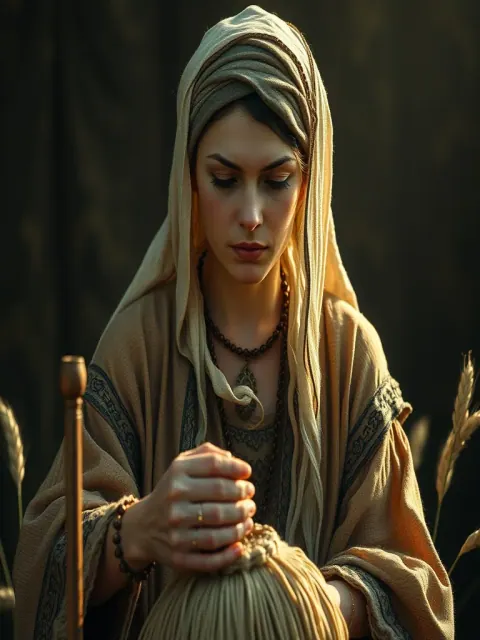
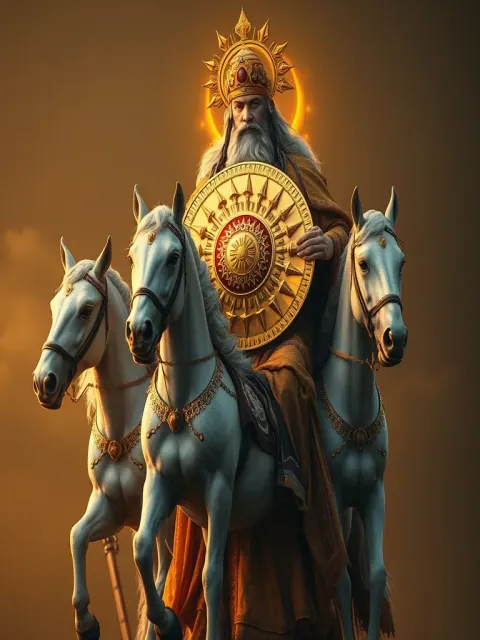
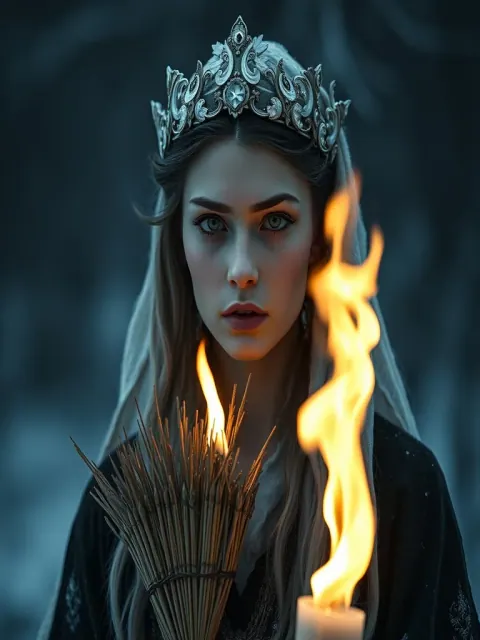
5 sections of this entry are open to everyone: the summary, the people, the symbols, the lineage and the sources. The other 9 (Name and epithets, In the ancient sources, The myths, Worship and archaeology, How the god was depicted, What scholars debate, After antiquity, Did you know?, Codex relic) are part of the full Codex: PRO opens the whole study of all 500 deities, and without a subscription you can read one full entry a day, just like in the app.
The Slavic deities were worshipped by the peoples of Eastern Europe, from Russia to the Balkans, before their Christianization. They venerated them in wooden idols and open-air sanctuaries, tied to the forces of nature and the seasons. With few written records, their beliefs survive mainly in folklore and popular traditions.
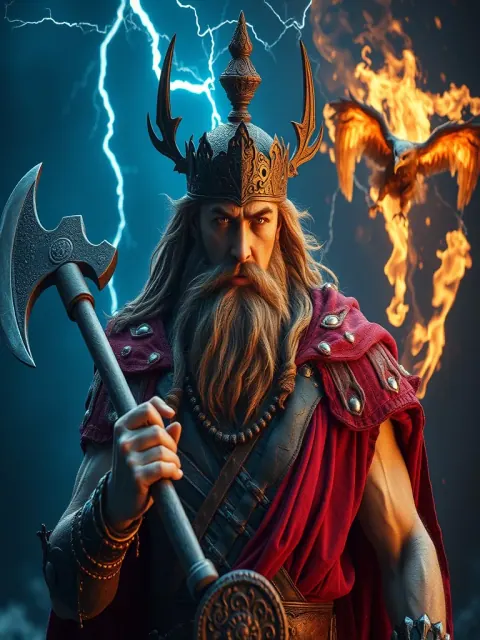
On Kupala night, the summer solstice, young people leapt over bonfires and floated flower crowns on the rivers. Maslenitsa saw off winter with pancakes in honor of the sun, and in Kiev prince Vladimir raised — and later toppled — a great idol of Perun.
01
At a glance
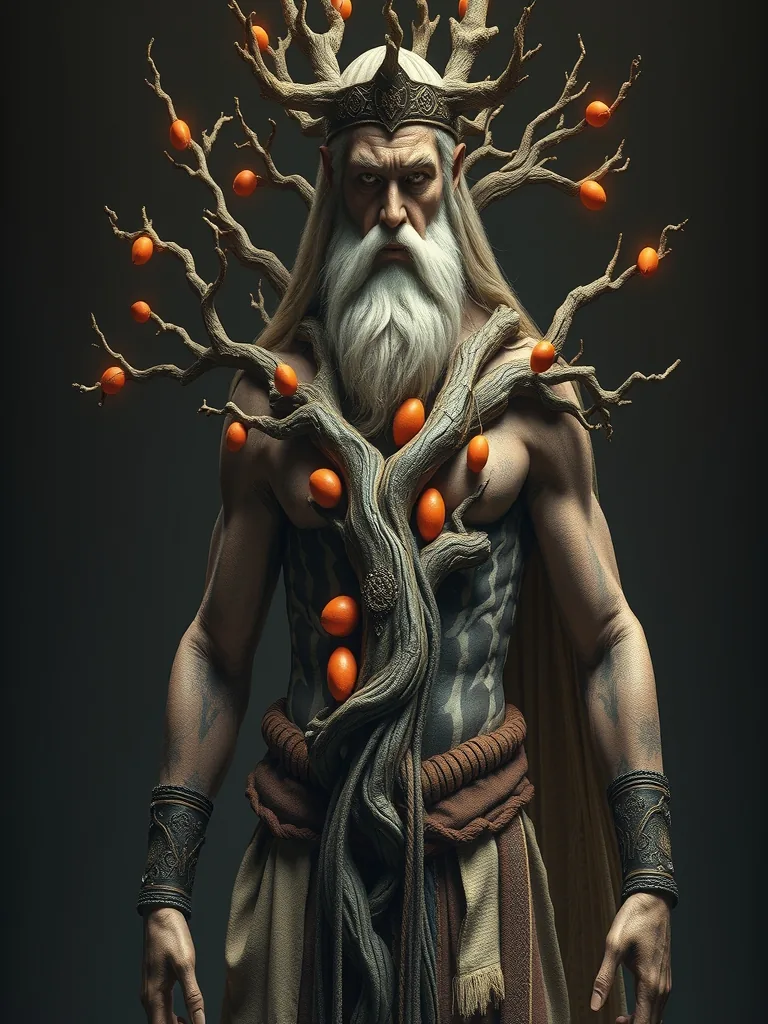
Rod (Old Church Slavonic and Old East Slavic: Родъ) is the prominent ancestral entity and mythical personification of kin, lineage, clan continuity, family generation, and personal fate within the traditional religion of the Eastern and Southern Slavs. Frequently documented across medieval ecclesiastical homilies, pastoral treatises, and confessional penitentials beginning in the 11th century, Rod was invoked almost invariably alongside the Rozhanitsy (Рожаницы) — female spirits associated with childbirth, maternal well-being, and the weaving of newborn destiny. The earliest and most influential written testimony concerning this devotion appears in the *Word of Saint Gregory the Theologian on How Pagans First Worshipped Idols* (preserved with medieval Slavic glosses from the 11th and 12th centuries), where the commentator laments that the ancient Slavs 'began to make offerings to Rod and the Rozhanitsy before Perun, their god'. Canonical texts from Kyivan Rus, notably the canonical inquiry Voproshanie Kirika (1136 CE), addressed by deacon Kirik to Bishop Nifont of Novgorod, and the moral treatise Word of the Christ-Lover (Slovo nikoego khristolyubtsa), attest that peasant women arranged bloodless ritual feasts of bread, fresh cheese, grain porridge (kasha), and honey mead (rozhanichnaya trapeza) to honor Rod following the birth of a child or during the ritual cutting of an infant's hair (postryzhennya). In the 20th century, Soviet archaeologist Boris Rybakov formulated the controversial hypothesis that Rod had been the primordial supreme creator god of all Slavs in an archaic agricultural stage. However, critical contemporary philology and history (led by Leo Klejn, Aleksander Gieysztor, Andrzej Szyjewski, and Stanisław Urbańczyk) have decisively refuted Rybakov's monotheistic claims, establishing that the Proto-Slavic root *\*rodъ* denoted simply 'kin, family, lineage, clan, and botanical yield', rendering Rod the tutelary genius of ancestral descent and biological-spiritual continuity.
7 min read · Reviewed on September 30, 2026 · How we research
02
Sacred symbols
The cosmic seed, the world egg, the family tree and the circle
03
Family
Rod
Unions
Rozhanitsy (mythic female personifications of childbirth, fate, and maternity)
Genealogy according to Slovo svyatogo Grigoriya Bogoslova o tom, kako pervoe pogani klanialisya idolom (sécs. XI–XII); Slovo nikoego khristolyubtsa (sécs. XI–XIV); Voproshanie Kirika (respostas do Bispo Nifont de Novgorod, 1136 d.C.); Comentário evangélico manuscrito do século XV; Penitenciais de São Sabas de Storozhi (século XVI)
04
Sources and further reading
Primary sources
Saint Gregory the Theologian (annotated medieval Slavic translation), Slovo svyatogo Grigoriya Bogoslova o tom, kako pervoe pogani klanialisya idolom. translation: Critical edition of the anti-idolatrous texts of Ancient Rus' preserved in university archives. read
Anonymous of Ancient Rus' (11th–14th centuries), Slovo nikoego khristolyubtsa (The censure of the tables dedicated to Rod and the Rozhanitsy). translation: Medieval Slavic ecclesiastical manuscript compiled in sources on pre-Christian religion. read
Kirik of Novgorod and Bishop Nifont (1136 AD), Voproshanie Kirika (Canonical answers on cutting cheese and bread for the Rozhanitsy). translation: Monuments of Old Russian Canon Law (academic edition by V. N. Beneshevich). read
Jan Máchal (professor of Slavic philology in Prague), Slavic Mythology (The Mythology of All Races, Vol. 3, Section I: The Genii of Destiny - Rod and Rozhanitsy). translation: Volume III of the comparative mythology collection, available digitally on the Internet Archive. read
Studies
Aleksander Gieysztor (historian of Warsaw), . Wydawnictwa Uniwersytetu Warszawskiego, Warsaw, 2006 d.C.. open
Andrzej Szyjewski (anthropologist of religion), . Wydawnictwo WAM, Kraków, 2003 d.C.. open
Leo Klejn (archaeologist and historian of Saint Petersburg), . Editora Evraziya, Saint Petersburg, 2004 d.C.. open
Evel Gasparini (comparative ethnologist), . Academic Council of Encyclopaedia Britannica Inc., 1973/2026. open
Name and epithets
The theonym Rod derives directly from the Proto-Slavic noun *\*rodъ*, whose expansive semantic scope encompassed 'family', 'birth', 'kinship', 'origin', 'clan lineage', and, in agricultural contexts, 'produce, crop yiel…
In the ancient sources
Word of Saint Gregory the Theologian on How Pagans Worshipped Idols, 11th century CE.. Attests that Slavs made offerings to Rod and the Rozhanitsy prior to the institution of Perun's state cult.
The myths
The Evolutionary Antiquity in the Homily of Saint Gregory. The primary medieval textual reference indicating the historical status of Rod occurs in the Slavic translation of the Word of Saint Gregory the Theologian.
Worship and archaeology
Veneration of Rod and the Rozhanitsy differed fundamentally from the public civic rituals of Vladimir's Kyivan pantheon. It involved neither monumental idols on public hilltops nor animal sacrifices.
How the god was depicted
No authentic monumental figurative idols of Rod survive from the pre-Christian period. While Boris Rybakov hypothesized that the top register of the four-headed Zbruch Idol (discovered in Galicia in 1848) depicted Rod a…
What scholars debate
Boris Rybakov's Supreme God Theory versus Modern Critique. The major debate in 20th-century Slavic studies surrounded Boris Rybakov's thesis (Yazychestvo drevnikh slavyan, 1981) asserting that Rod was the primordial mon…
After antiquity
In recent decades, Rod has been adopted as the central figure in contemporary Slavic Native Faith movements (Rodnovery).
Did you know?
Canonical inquiries from 1136 in Novgorod record that deacon Kirik specifically asked his bishop whether it was sinful for women to offer bread and cheese to Rod and Rozhanitsy, receiving a stern confirmation.
Codex relic
Seed of the World. The primordial cosmic seed from which the whole universe, the gods, and life sprang.
The rest of this scroll is sealed
The legends, the myth, the cult and relics are part of the full Codex. You can open 1 full entry for free every day; to open all 500 deities with no limits and no ads, subscribe to Codex PRO.