CMCodex
Back to the Codex
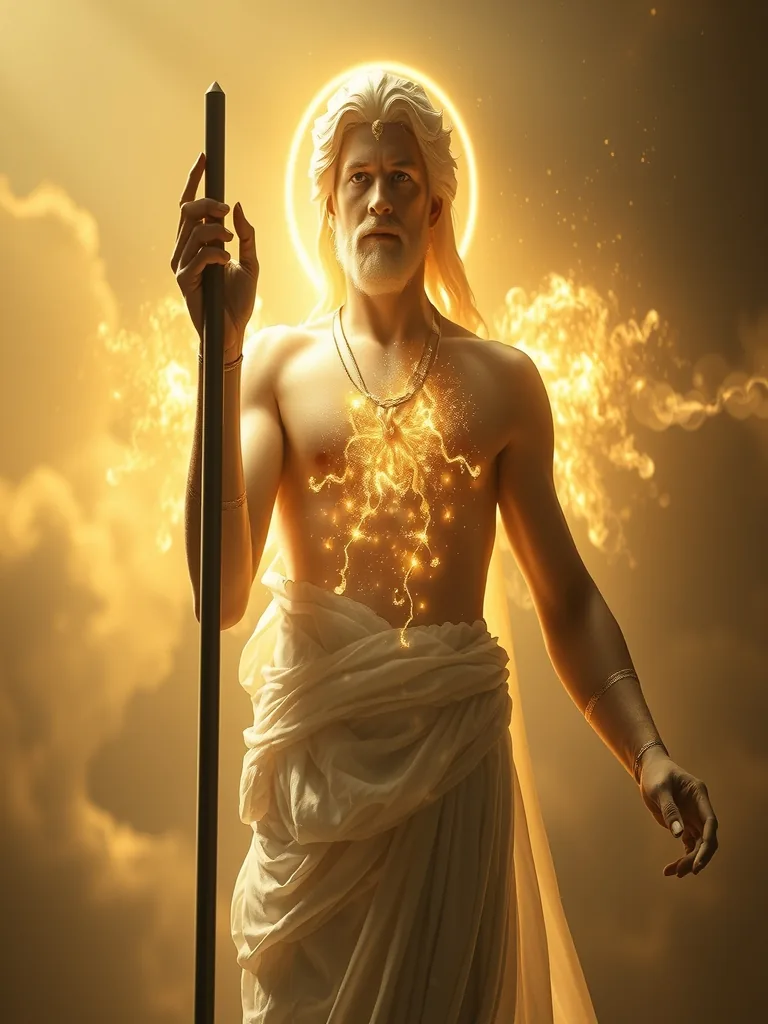
3D relief portrait of Aether
Greek
Tap or drag
Greek

Aether

The Primordial Upper Light

Domain
Heavenly Light & Upper Air
Alignment
Luminous Primordial
Element
Light
Relics of Power
The Radiance of the Firmament
Speak with Aether

The People

People
Ancient Greeks
Region
Greece & the Mediterranean
Period
8th c. BC – 4th c. AD

The Olympian gods were worshipped by the city-states of ancient Greece, from Athens to Sparta, which raised them temples such as the Parthenon. Reigning atop Mount Olympus, they presided over every aspect of life and were celebrated in festivals like the Olympic Games. Homer and Hesiod fixed their myths, which shaped all of Western culture.

The Olympic Games were held every four years in honor of Zeus, and the Panathenaea celebrated Athena in Athens. The Eleusinian Mysteries initiated the faithful into the secrets of Demeter and Persephone, while crowds consulted Apollo's oracle at Delphi.
The Sacred Scrolls

Aether is the primordial personification of the upper light, the celestial quintessence that permeates the unreachable heights where only gods dare to dwell. Born of the paradoxical union between Erebus, the deep darkness, and Nyx, the primordial night, he represents the luminous spark that ordered the initial chaos. His presence is immaterial, almost invisible to human eyes, manifesting as a bluish, ethereal glow that bathes the firmament. Unlike Helios, who is the solar disk, Aether is the very substance of luminosity, the rarefied and pure air that grants immortality. In his passive majesty, he does not interfere in earthly affairs, preferring to observe the dance of the celestial spheres from his untouchable vault. Mount Olympus rises to reach his domains, forever bathing in his glory. For ancient philosophers, he was not merely a god, but the fifth fundamental element that sustained all creation. Thus, Aether remains the eternal guardian of the boundary between the habitable sky and the endless void.

Sacred Symbols

Heavenly light, upper sky, blue radiance, the starry vault, the immaculate air

Divine Lineage

Son of Erebus (Darkness) and Nyx (Night). Brother and consort of Hemera (Day). In some ancient traditions, father of Uranus (the Sky).

The Legendary Myth

In the beginning of all things, when Chaos still dictated the rules of non-existence, the unlikely union of Erebus and Nyx generated the first sparks of order in the universe. From this embrace between absolute darkness and endless night sprang Aether, the purest light, tearing the shadowy veil with his undeniable presence. His ascension formed the highest layers of the universe, pushing the heavy air and earthly mists downward, thus establishing the boundary between the sacred and the profane. It is said that the first gods, thirsting for eternal life, climbed the highest mountains just to sip a breath of this crystalline air. Aether became the canvas upon which Uranus, the Sky, painted his constellations, and the road where the Sun's chariot travels daily. He rarely descended to solid earth, for his pure touch would vaporize the gross matter of mortals in the blink of an eye. In one of his rare direct acts, it is said he wrapped the fallen Titans in a burning mist before they were cast into Tartarus, sealing their prison. His light is so intense that even Zeus revered his primordial existence before hurling his thunderbolts. Mythology celebrates him not for strife and violent passions, but as the eternal shining foundation that allows life to flourish. His central triumph is the very continuous existence of light against the crushing pressure of the initial Void.

Legends & Deeds

A little-known secondary narrative from the Orphic mysteries recounts the moment of cosmic tension when the monster Typhon threatened to overthrow the Olympian gods. As the beast hurled mountains toward the heavens, threatening to pierce the starry dome, Aether materialized as a shimmering barrier of unbearable heat. Typhon's storming winds crashed against the ethereal boundary and disintegrated, unable to pollute the divine air with the pestilent breath of the underworld. Aether used no physical weapons, but simply concentrated his own pure essence, creating a wall of solid light that blinded the monster's hundred heads. It was this hesitation, caused by the blinding glare, that allowed Zeus to wield his thunderbolts and subdue the abomination. Despite being a force often forgotten in heroic legends, poets whispered that it was Aether who purified the ashes left by the cosmic battles, restoring peace to the firmament. His serenity, however, is relentless; any creature of darkness that attempted to cross his domains was instantly obliterated. This episode cemented his image as the silent shield, the ultimate guardian who protects the celestial palace from any mortal or monstrous taint.

Cult & Worship

The cult of Aether was notably rare among common people, who considered him too elevated and distant to comprehend earthly prayers. His true devotees were found among the initiates of the Orphic Mysteries and the early naturalistic philosophers of Greece. There were no great stone temples erected in his name, as it was believed that the clear, bright sky itself was his immaculate sanctuary. Rituals in his honor frequently took place on the highest mountain peaks, at the break of dawn or beneath the zenith of the summer sun. Priests dressed in shimmering blue tunics burned rare incenses, whose thin smokes rose high, symbolizing the mortal soul's quest for celestial purification. Blood sacrifices were strictly forbidden on his altars; only chants, hymns, and the burning of precious resins that perfumed the winds were offered. Annually, at the height of the summer solstice, small philosophical fraternities celebrated the 'Ethereal Days', meditating on the nature of the eternal soul and its connection to the stars. Today, the concept of Aether survives more in the history of science and philosophy than in active religion, marking humanity's eternal search for the universe's quintessence.

Relics of Power

The pure, incorruptible light the gods breathe high in the sky, above the impure and dense air of mortals. This primordial radiance illuminates the divine dwellings, granting eternal vigor to those who feed upon it. It is the essence of brightness that drives away the absolute darkness of the abyss, forging the shining dome that protects the cosmos.

Did You Know?

The word 'aether' gave rise to the term 'ethereal', used to describe something of fragile, heavenly, or otherworldly beauty. Aristotle popularized Aether as the Fifth Element (the Quintessence), believing it to be the substance that composed stars and planets. In 19th-century physics, scientists hypothesized the existence of 'luminiferous aether', an invisible medium that would allow light waves to propagate through the vacuum of space. In various fantasy and science fiction works, such as tabletop RPGs and video games, 'Aether' is often portrayed as pure magical energy or crystallized mana. Even the famous cryptocurrency network Ethereum took its name from this ancient cosmic concept, evoking an invisible, omnipresent network.

From the same pantheon

View pantheon