
Skip to content
CodexMythologia
Back to the Codex
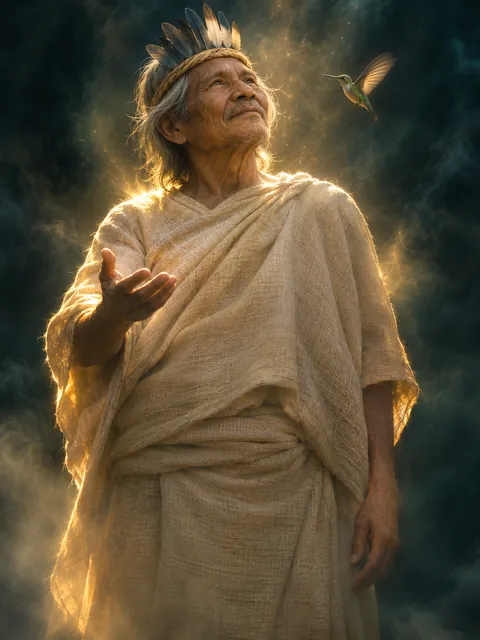
Portrait of Jaci, Indigenous deity
Indigenous
Tap or drag
Indigenous

Jaci

The Goddess of the Moon

Domain
Night & Protection
Alignment
Neutral Good
Element
Air
Relics of Power
Lunar Silver Mirror
Speak with Jaci

The full Codex

4 sections of this entry are open to everyone: the summary, the people, the symbols, the lineage and the sources. The other 9 (Name and epithets, In the ancient sources, The myths, Worship and archaeology, How the god was depicted, What scholars debate, After antiquity, Did you know?, Codex relic) are part of the full Codex: PRO opens the whole study of all 500 deities, and without a subscription you can read one full entry a day, just like in the app.

The People

People
Indigenous peoples of Brazil
Region
Brazil & South America
Period
pre-colonial – present

The Indigenous spirits and culture heroes are revered by the native peoples of Brazil, such as the Tupi, Guarani, and Yanomami. Their beliefs, passed down orally by shamans and elders, bind humans to the forest, the rivers, and the ancestors. They remain alive in the Indigenous communities that endure to this day.

Shamans lead rituals with songs, rattles, and sacred plants, mediating contact with the spirits of the forest. In the Upper Xingu, the Quarup honors illustrious dead with dances and wrestling, and cauim feasts gather entire villages in ceremonial celebrations.


At a glance

Jaci, also spelled Jacy or Yasseuh in early records, is the Moon in traditions documented among speakers of Tupi languages. Claude d'Abbeville recorded the Maranhão Tupinambá's knowledge of its phases, the tides, and a star that pursued it. In the nineteenth century, Couto de Magalhães presented Jacy as the mother of plants, but his arrangement of a general theogony is the author's interpretation. The records provide no continuous biography and do not confirm that Jaci was Guaraci's wife or was created by Tupã.

The ancient sources on this deity are scarce. This study gathers only what is on record.

6 min read · Reviewed on October 13, 2026 · How we research

Sacred symbols

Moon, silver, water and the night

Sources and further reading

Primary sources

  • Claude d'Abbeville, Histoire de la mission des pères capucins en l'isle de Maragnan et terres circonuoisines (Paris, 1614), original French text. read
  • Claude d'Abbeville, Histoire de la mission des pères capucins en l'isle de Maragnan (1614). translation: History of the mission of the Capuchin fathers on the island of Maranhão, trans. Cezar Augusto Marques (1874). read
  • José Vieira Couto de Magalhães, O Selvagem (1876). read
  • Machado de Assis, Americanas: Lua Nova (1875). read

Studies

  • Isabelle Combès, Yaci: mythes et représentations tupi-guarani de la lune. L'Homme 31 (120), 1991. open
  • Flávia Pedroza Lima and Ildeu de Castro Moreira, Tradições astronômicas tupinambás na visão de Claude d'Abbeville. Revista da Sociedade Brasileira de História da Ciência 3 (1), 2005. open
  • Flavia Pedroza Lima and Silvia Fernanda de Mendonça Figueirôa, Etnoastronomia no Brasil: a contribuição de Charles Frederick Hartt e José Vieira Couto de Magalhães. Boletim do Museu Paraense Emílio Goeldi. Ciências Humanas 5 (2), 2010. open

Name and epithets

The form Jaci exists alongside spellings such as Jacy and Yasseuh, products of records made at different times and in different languages.

In the ancient sources

Histoire de la mission des pères capucins en l'isle de Maragnan, 1614. Claude d'Abbeville records celestial terms and observations of the Maranhão Tupinambá; his text is a missionary chronicle. O Selvagem, 1876.

The myths

The star that pursues the Moon. In Claude d'Abbeville's account, the Maranhão Tupinambá called a red star that seemed to follow the Moon Iaouäre.

Worship and archaeology

D'Abbeville describes observations of lunar phases and the link between the full Moon, the new Moon, and tides among the Maranhão Tupinambá.

How the god was depicted

The chronicles consulted discuss the visible Moon and names given to celestial phenomena; they do not describe a cult image or material attributes of Jaci.

What scholars debate

A theogony reconstructed in the nineteenth century. Couto de Magalhães organizes the Sun, Moon, and Rudá as higher divinities and calls the Moon the mother of plants.

After antiquity

In the poem Lua Nova (1875), Machado de Assis calls Jacy the mother of fruits and imagines warriors, young people, and elders greeting the celestial body. The poem is a nineteenth-century Brazilian literary creation.

Did you know?

D'Abbeville records Yaseuh pouyton for a lunar eclipse, translated as 'night of the Moon'. The name of the phenomenon is not, by itself, an account of its cause.

Codex relic

Lunar Silver Mirror. A mirror of water revealing hidden intentions of men in the night.

The rest of this scroll is sealed

The legends, the myth, the cult and relics are part of the full Codex. You can open 1 full entry for free every day; to open all 500 deities with no limits and no ads, subscribe to Codex PRO.

See Codex PROGet it on Google Play

From the same pantheon

View pantheon