Skip to content
CodexMythologia
Back to the Codex
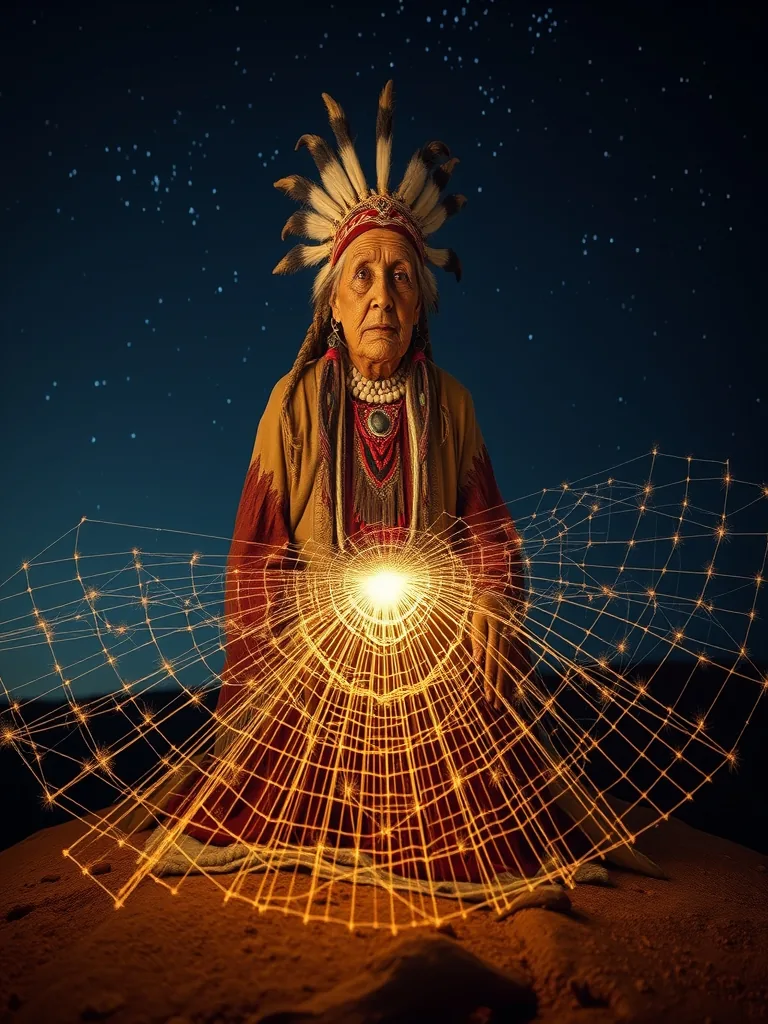
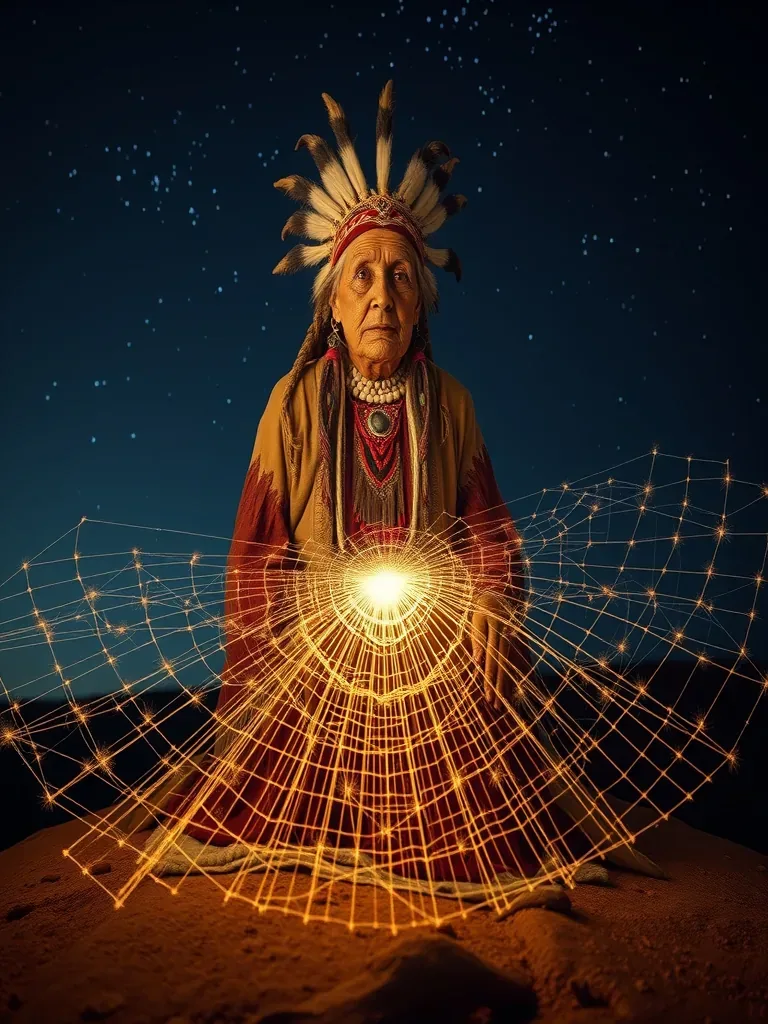
Portrait of Spider Grandmother, Native American deity
Native American
Tap or drag
Native American

Spider Grandmother

The Weaver of Creation

Domain
Creation, Wisdom & Protection
Alignment
Lawful Good
Element
Earth
Relics of Power
Thread of the World
Speak with Spider Grandmother

The full Codex

5 sections of this entry are open to everyone: the summary, the people, the symbols, the lineage and the sources. The other 9 (Name and epithets, In the ancient sources, The myths, Worship and archaeology, How the god was depicted, What scholars debate, After antiquity, Did you know?, Codex relic) are part of the full Codex: PRO opens the whole study of all 500 deities, and without a subscription you can read one full entry a day, just like in the app.

The People

People
Native American peoples
Region
North America
Period
pre-colonial – present

These spirits and deities were worshipped by the many Native peoples of North America, from the Lakota to the Navajo and Iroquois. Their beliefs bind humans to the Great Spirit, to totem animals, and to balance with the land. Passed down orally, they survive in the Indigenous nations that endured colonization.

The Sun Dance gathered the Plains nations in fasting and sacrifice around the sacred tree. The Hopi dance with the kachinas, masked spirits of the rains, and the sacred pipe seals prayers and treaties — ceremonies still alive in today's nations.
At a glance

Spider Grandmother (known as Kóokyangwúuti or Gogyeng Sowuhti among the Hopi, Naʼashjéʼii Asdzáá within the Navajo/Diné Nation, and Ts'its'tsi'nako or Thought-Woman among the Keresan Pueblos) is one of the most revered sacred beings across Indigenous cultures of the American Southwest. Far from an ordinary zoomorphic figure, Spider Grandmother serves as cosmic architect, heroic savior during primordial transitions between worlds, and teacher of vital arts and ceremonial disciplines. As documented in early ethnographic field studies by H. R. Voth, Alexander M. Stephen, Washington Matthews, and Franz Boas, the elderly spider deity features prominently in foundational emergence and creation cycles. In Hopi traditions, she collaborates with the sun deity to fashion mortal beings from clay and guides human clans through a hollow reed up through the subterranean aperture (sipapu) to reach the surface of the Fourth World (Tuwaqachi). In Diné epic mythology, Naʼashjéʼii Asdzáá shelters the Hero Twins—Monster Slayer (Naayééʼ Neezghání) and Born for Water (Tóbájíshchíní)—within her subterranean chamber beneath Spider Rock, gifting them eagle feather amulets and protective incantations to safely cross crushing mountains and slashing reeds to meet their father, the Sun. Moreover, Diné culture reveres Spider Woman as the primordial patroness who bestowed the sacred art of loom weaving, constructing a cosmic frame strung with sunbeams, lightning, and sheet clouds.

7 min read · Reviewed on September 29, 2026 · How we research

Sacred symbols

The web, the thread of life, the spider and the sipapu (place of emergence)

Family

Spider Grandmother
Unions
Spider Man (Naʼashjéʼii Hastiin, consort in Diné traditions who helped construct the cosmic frame of the primordial loom)
Children
Pöqanghoya and Palöngawhoya (the Twin War Gods in Hopi tradition, fostered and guided as grandsons); in Keresan traditions of Acoma and Laguna, brought forth through thought the primordial sisters Nautsiti and Iyatiku
Genealogy according to H. R. Voth, The Traditions of the Hopi (1905, pp. 1–15); Washington Matthews, Navaho Legends (1897, pp. 108–114); Franz Boas, Keresan Texts (1928, pp. 1–12); Alexander M. Stephen, Hopi Journal (1936, pp. 150–153); Jesse Walter Fewkes, Hopi Katcinas Drawn by Native Artists (1903, pp. 107–108)

Sources and further reading

Primary sources

  • Voth, H. R., The Traditions of the Hopi (Field Columbian Museum Publication 96, Anthropological Series, Vol. VIII). translation: Chicago: Field Columbian Museum, 1905. read
  • Matthews, Washington, Navaho Legends (Memoirs of the American Folk-Lore Society, Vol. V). translation: Boston and New York: Houghton, Mifflin and Company, 1897. read
  • Stephen, Alexander M. (ed. Elsie Clews Parsons), Hopi Journal of Alexander M. Stephen (Columbia University Contributions to Anthropology, Vol. XXIII). translation: New York: Columbia University Press, 1936. read
  • Boas, Franz, Keresan Texts (Publications of the American Ethnological Society, Vol. VIII, Part 1). translation: New York: G. E. Stechert & Co., 1928. read
  • Fewkes, Jesse Walter, Hopi Katcinas Drawn by Native Artists (Twenty-First Annual Report of the Bureau of American Ethnology). translation: Washington: Government Printing Office, 1903. read

Studies

  • Reichard, Gladys A., Navaho Religion: A Study of Symbolism. New York: Pantheon Books (Bollingen Series XVIII), 1950. open

Name and epithets

The traditional Hopi name is formed from the noun 'kóokyangw' (spider) and the suffix 'wúuti' (woman or elder female), yielding Kóokyangwúuti ('Spider Woman') or the respectful kinship title Gogyeng Sowuhti ('Spider Gra…

In the ancient sources

The Traditions of the Hopi, 1905 CE. H. R. Voth compiles comprehensive Hopi emergence narratives detailing Kóokyangwúuti's role in guiding clans through the subterranean worlds. Navaho Legends, 1897 CE.

The myths

The Emergence of Clans and the Hollow Reed Pathway. In the Hopi creation narrative recorded by H. R. Voth at Oraibi, ancestral humans dwelt deep within the dark Third Underworld, where rising discord, witchcraft, and mo…

Worship and archaeology

Religious devotion to Spider Grandmother across the Southwest centers upon quiet household veneration, clan customs, and specialized kiva rituals.

How the god was depicted

In Southwest archaeological and ethnographic material culture, Spider Grandmother's presence is represented through both geometric and figurative symbolism.

What scholars debate

. Within American anthropology and Indigenous religious studies, Spider Woman's traditions have anchored important debates regarding cultural diffusion, material history, and gender authority.

After antiquity

Spider Grandmother has profoundly influenced contemporary Indigenous literature, feminist theory, and Southwestern cultural resurgence.

Did you know?

A widely observed custom among traditional Navajo weavers is the incorporation of a 'spirit line' (chʼihónítʼiʼ), a single warp thread of contrasting color woven through the border to the outer edge of a rug.

Codex relic

Thread of the World. The thread with which she weaves life, guiding the peoples through the underworlds up into the light.

The rest of this scroll is sealed

The legends, the myth, the cult and relics are part of the full Codex. You can open 1 full entry for free every day; to open all 500 deities with no limits and no ads, subscribe to Codex PRO.

See Codex PROGet it on Google Play

From the same pantheon

View pantheon