5 sections of this entry are open to everyone: the summary, the people, the symbols, the lineage and the sources. The other 9 (Name and epithets, In the ancient sources, The myths, Worship and archaeology, How the god was depicted, What scholars debate, After antiquity, Did you know?, Codex relic) are part of the full Codex: PRO opens the whole study of all 500 deities, and without a subscription you can read one full entry a day, just like in the app.
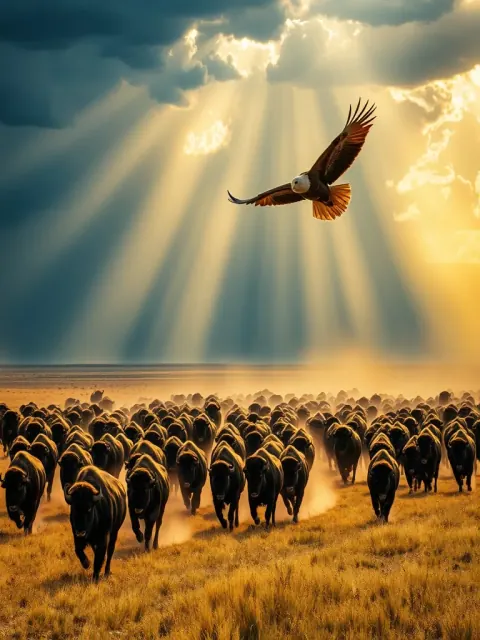
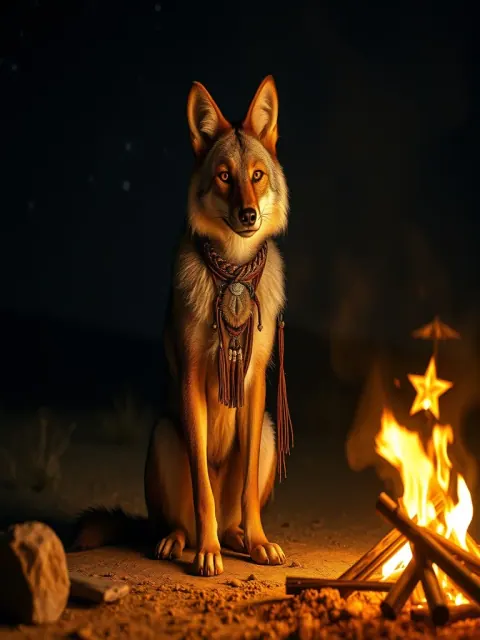
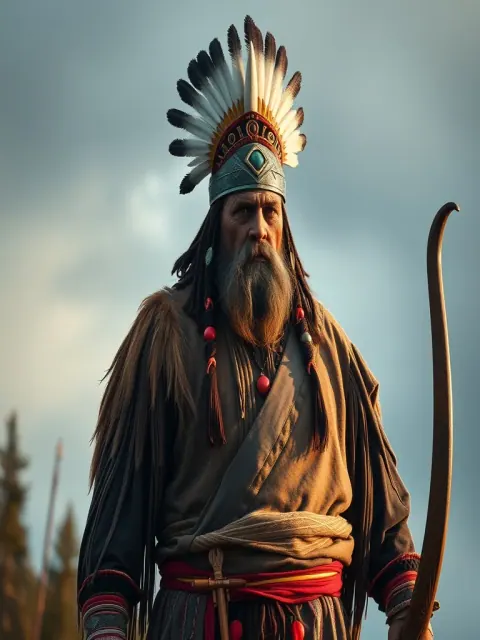
These spirits and deities were worshipped by the many Native peoples of North America, from the Lakota to the Navajo and Iroquois. Their beliefs bind humans to the Great Spirit, to totem animals, and to balance with the land. Passed down orally, they survive in the Indigenous nations that endured colonization.
The Sun Dance gathered the Plains nations in fasting and sacrifice around the sacred tree. The Hopi dance with the kachinas, masked spirits of the rains, and the sacred pipe seals prayers and treaties — ceremonies still alive in today's nations.
01
At a glance
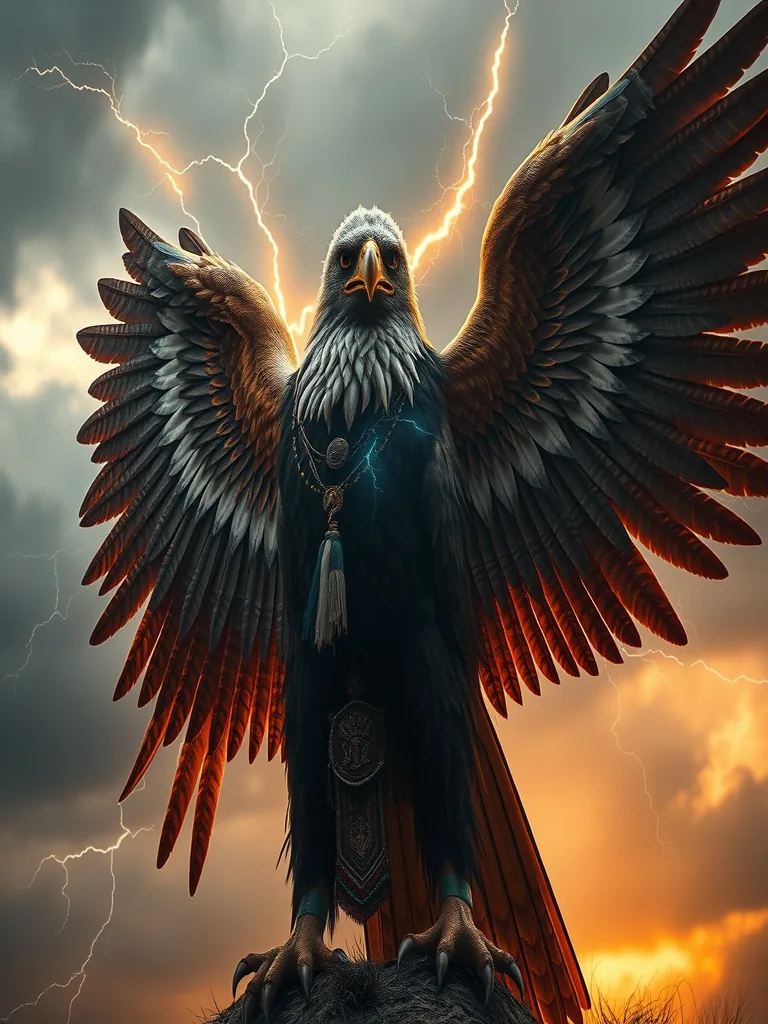
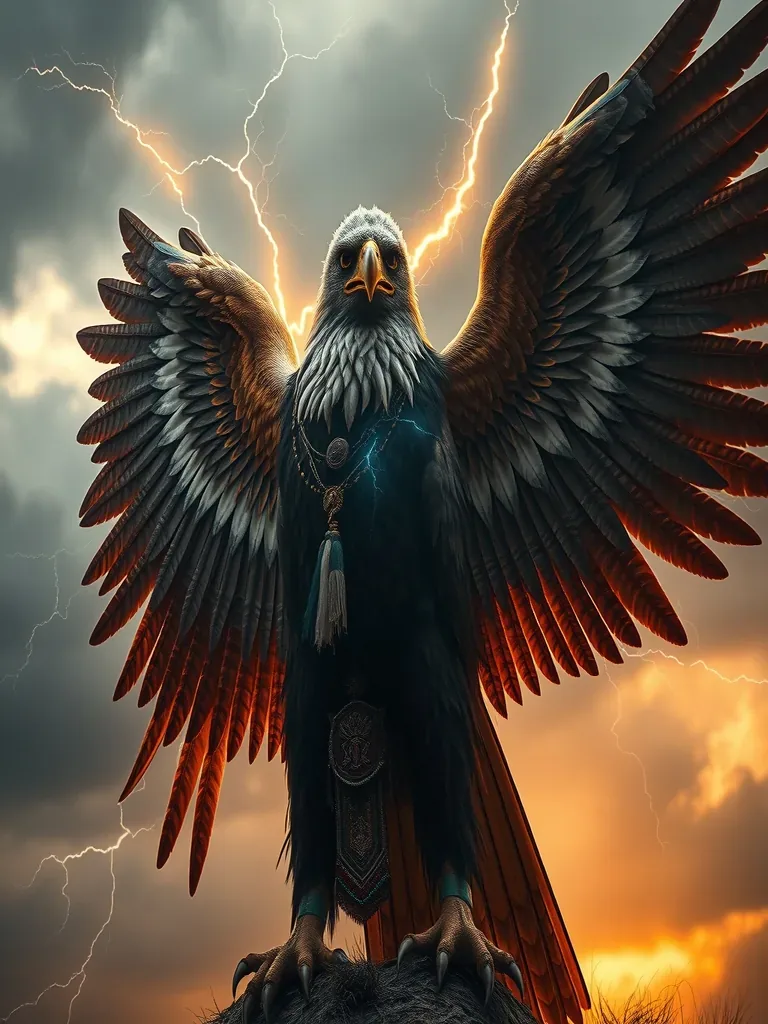
The Thunderbird (designated Wakíŋyaŋ among the Lakota and Dakota, Animikii or Binesi among the Anishinaabe/Ojibwe, Kwunusela among the Kwakwaka'wakw, and venerated under numerous other indigenous theonyms) is one of the most sublime and awe-inspiring spiritual powers across North American indigenous cosmologies, commanding supreme religious authority throughout the Great Plains, the Great Lakes, the Eastern Woodlands, and the Pacific Northwest. Far from representing an ordinary folkloric raptor or decorative emblem, the Thunderbird constitutes an overarching cosmic order of celestial beings embodying the kinetic fury of lightning, the reverberating percussion of thunder, and the life-giving bestowal of seasonal rains. As extensively recorded in anthropological studies by James R. Walker, Franz Boas, William Jones, and Paul Radin, Thunder Beings dwell upon the highest, cloud-shrouded mountain peaks or within the celestial upper vault beyond storm clouds. The blinking of their fiery eyes flashes piercing lightning bolts across the atmosphere, while the mighty beat of their storm-laden wings generates howling gales and the deep roll of thunder shaking the earthly crust. Within indigenous metaphysical ecology, Thunderbirds wage continuous warfare against chthonic, underwater agencies of chaos—epitomized by Horned Serpents (Unhcegila among the Sioux) and the Underwater Panther (Mishipeshu among the Ojibwe)—ensuring that subterranean monsters do not overwhelm human survival. In Pacific Northwest coastal cultures, Kwunusela serves additionally as a paramount crest ancestor and mythic whale predator, lifting killer whales straight out of ocean swells with stone talons and transporting them to mountain eyries for sacred consumption.
7 min read · Reviewed on September 29, 2026 · How we research
02
Sacred symbols
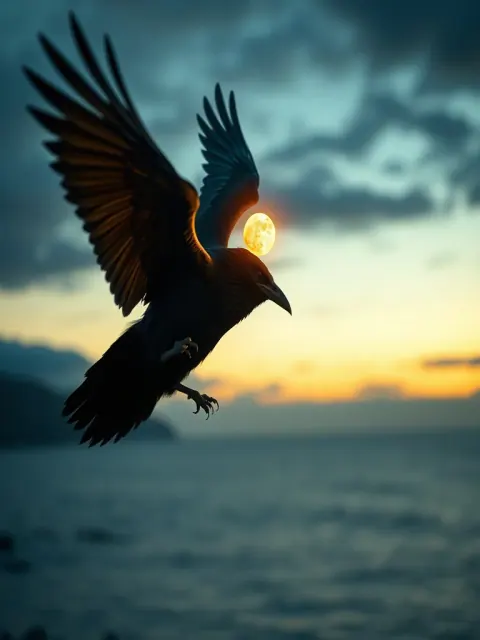
The colossal eagle, the lightning, the storm cloud and the defeated serpent
03
Family
Parents
Škaŋ (the Lakota Sky Motion) or Kitchi Manitou (the Great Spirit in Algonquian cosmologies), as the primordial source of celestial forces
Thunderbird
Genealogy according to James R. Walker, The Sun Dance and Other Ceremonies of the Oglala Division of the Teton Dakota (1917); Franz Boas, The Social Organization and the Secret Societies of the Kwakiutl Indians (1897); William Jones, Ojibwa Texts (1919); Paul Radin, The Winnebago Tribe (1923)
04
Sources and further reading
Primary sources
Boas, Franz, The Social Organization and the Secret Societies of the Kwakiutl Indians (Report of the U.S. National Museum for 1895). translation: Washington, D.C.: Government Printing Office, 1897. read
Jones, William, Ojibwa Texts (Publications of the American Ethnological Society, Vol. VII, Part II). translation: Leyden: E. J. Brill, 1919. read
Walker, James R., The Sun Dance of the Teton Dakota (AMNH Anthropological Papers, Vol. XVI, Part II). translation: New York: Published by order of the Trustees of the AMNH, 1917. read
Radin, Paul, The Winnebago Tribe (Thirty-Seventh Annual Report of the Bureau of American Ethnology). translation: Washington, D.C.: Government Printing Office, 1923. read
Studies
Lévi-Strauss, Claude, The Way of the Masks. Seattle: University of Washington Press, 1982. open
Gill, Sam D. & Sullivan, Irene F., Dictionary of Native American Mythology. Santa Barbara: ABC-CLIO, 1992. open
Brown, Joseph Epes & Black Elk, The Sacred Pipe: Black Elk's Account of the Seven Rites of the Oglala Sioux. Norman: University of Oklahoma Press, 1953. open
McGaa, Ed, Mother Earth Spirituality: Native American Paths to Healing Ourselves and Our World. San Francisco: HarperSanFrancisco, 1990. open
Name and epithets
The Lakota-Dakota theonym is Wakíŋyaŋ, compounded from wakȟáŋ ('sacred', 'mysterious', 'supernatural') and the verbal root denoting winged movement or breathing, signifying 'The Sacred Winged Beings' or 'Those Flying in…
In the ancient sources
The Sun Dance: Oglala Division of the Teton Dakota (AMNH), 1917 CE. Authoritative primary ethnographic account by James R. Walker detailing the four aspects of Wakíŋyaŋ and their role in the Sun Dance ritual.
The myths
The Cosmic Combat Against the Horned Serpent of the Deep Waters. In the cosmological accounts of the Lakota and Ojibwe transcribed by James R.
Worship and archaeology
Ceremonial engagement with the Thunderbird varied by geographic region, yet consistently centered on profound reverence for the regenerative and destructive capacities of storm phenomena.
How the god was depicted
Thunderbird iconography is among the most pervasive and distinct in North American indigenous art. On towering red-cedar totem poles carved by Haida, Tlingit, Nuu-chah-nulth, and Kwakwaka'wakw artists, Kwunusela almost…
What scholars debate
. Scholarly discourse surrounding the Thunderbird in comparative ethnology and archaeology has focused on structural cosmology and ecological foundations.
After antiquity
The Thunderbird has become an enduring emblem in North American civic, military, and artistic culture. It appears on municipal coats of arms throughout Canada and the United States, military squadron insignia for the Un…
Did you know?
Lakota holy men described Wakíŋyaŋ to James R. Walker as an incorporeal, formless power possessing paradoxical attributes: having no definite head or limbs, but bearing a sharp beak without a mouth, wings with twelve mi…
Codex relic
Lightning Feathers. The wings whose beating makes the thunder roll and whose gaze hurls lightning upon the earth.
The rest of this scroll is sealed
The legends, the myth, the cult and relics are part of the full Codex. You can open 1 full entry for free every day; to open all 500 deities with no limits and no ads, subscribe to Codex PRO.