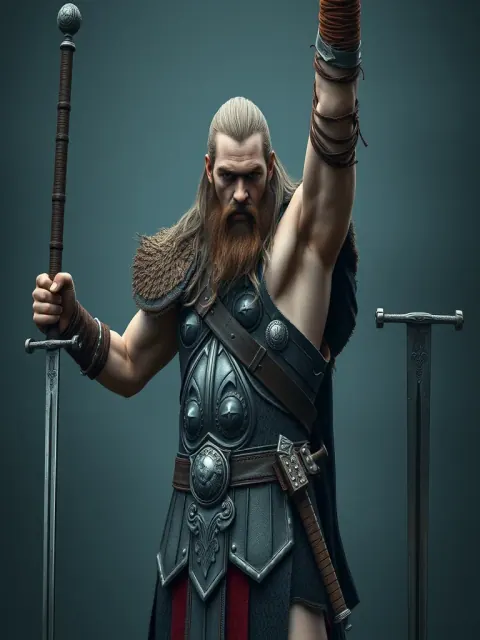
4 sections of this entry are open to everyone: the summary, the people, the symbols, the lineage and the sources. The other 9 (Name and epithets, In the ancient sources, The myths, Worship and archaeology, How the god was depicted, What scholars debate, After antiquity, Did you know?, Codex relic) are part of the full Codex: PRO opens the whole study of all 500 deities, and without a subscription you can read one full entry a day, just like in the app.
The gods of Asgard were worshipped by the Norse peoples of Scandinavia and by the Germanic tribes, especially during the Viking Age. Warriors sought to die in battle to reach Odin's Valhalla, and the myths were preserved in the Icelandic Eddas. The cult declined with the region's Christianization around the year 1000.
The Norse celebrated blóts, seasonal sacrifices with feasts of meat and mead, such as the Yule of the winter solstice. The great temple at Uppsala, in Sweden, hosted every nine years one of the largest sacrificial festivals of the Viking world.
01
At a glance
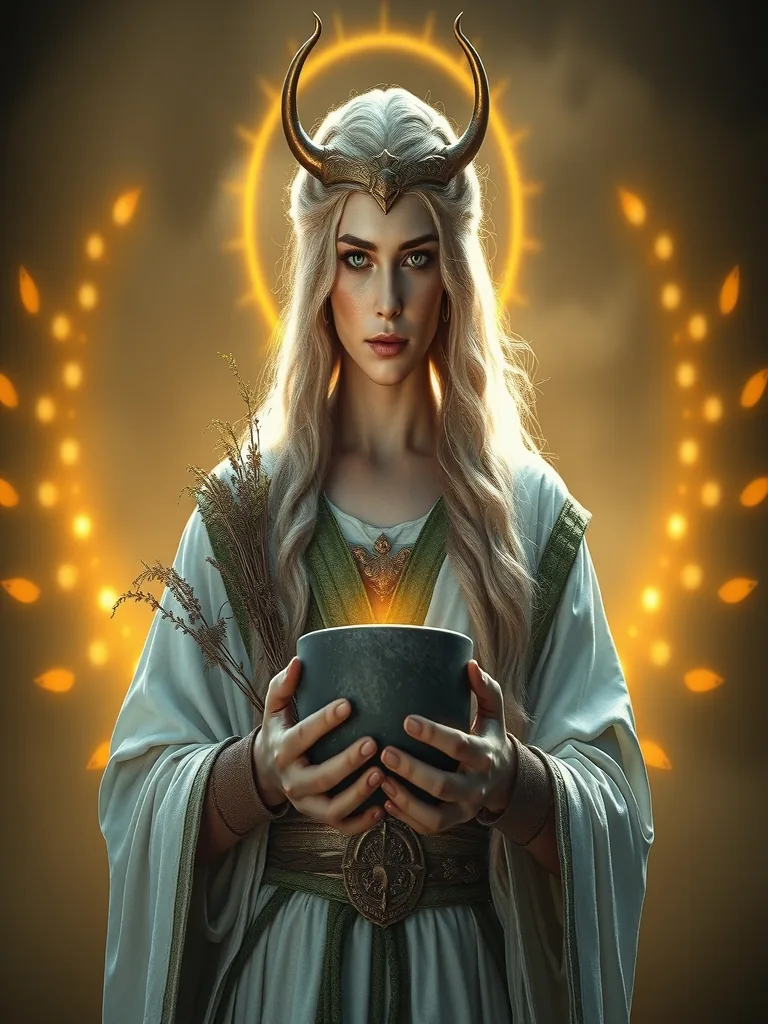
Eir is a female name tied to healing that appears in medieval Norse sources without those sources describing the figure in the same way. In the Gylfaginning, the first part of Snorri Sturluson's Prose Edda (thirteenth century), the speaker called Hár lists the ásynjur, the goddesses, and says: «Þriðja er Eir. Hon er læknir beztr», that is, «The third is Eir. She is the best physician» (our translation from the Old Norse text published at heimskringla.no). This is chapter XXXV in Brodeur's translation and paragraph 36 (in his chapter X) in the translation by Rasmus B. Anderson. Snorri adds nothing more about her.
In the poem Fjölsvinnsmál, the second part of what editors call Svipdagsmál, Eir is one of the nine maidens who sit at the knees of Menglöð, the lady of the hall ringed with flames, on the hill called Lyfjaberg, the «hill of healing». The watchman Fjölsviðr says that these maidens help those who make sacrifices to them. Bellows's edition warns that the poem survives only in paper manuscripts of the seventeenth century or later and that its author often erred in matters of mythology, so this testimony cannot be treated as an account of an ancient cult.
A third source, the series of name lists called Nafnaþulur, places Eir among «Óðinn's maidens», the valkyries, and not among the goddesses of the earlier stanzas. The name is also used in verse: in Gísla saga, Gísli composes stanzas in which a woman is designated by the formula Eir aura, «Eir of riches», and a wooden stick from Bergen, from about 1300, is said to use the same convention, according to the English Wikipedia summary that cites MacLeod and Mees.
Eir is also a common noun. The dictionary of Cleasby and Vigfusson records eir as «peace, clemency», a word of old poetry that does not appear in prose. Zoëga has the related feminine noun eirð, «clemency, mercy», and records separately a neuter homonym eir, «brass, copper». This study presents only what these sources say. Where they are silent, the corresponding fields are marked as fragmentary, and the hypotheses of scholars appear as hypotheses.
The ancient sources on this deity are scarce. This study gathers only what is on record.
17 min read · Reviewed on October 14, 2026 · How we research
02
Sacred symbols
The medicinal herbs, the mortar, the hill and the healing hand
Snorri Sturluson, Gylfaginning (The Younger Edda). translation: Rasmus B. Anderson (1897). read
Sæmundur fróði / Snorri Sturluson, The Elder Eddas of Saemund Sigfusson; and the Younger Eddas of Snorre Sturleson (Fjölsvinnsmál 36-42; Gylfaginning). translation: Benjamin Thorpe e/and J. A. Blackwell (1866). read
Anônimo / Anonymous, Svipdagsmál (Grógaldr and Fjölsvinnsmál), with notes. translation: Henry Adams Bellows (1923), The Poetic Edda. read
Anônimo / Anonymous, Nafnaþulur (stanzas 23-26). translation: Translation at vikingr.org (translator not identified on the page). read
Anônimo / Anonymous, Gísla saga Súrssonar (chapter 22, Old Norse text). translation: Old Norse text. read
Snorri Sturluson, Gylfaginning (digital transcription that prints «Fir»). translation: Arthur Gilchrist Brodeur (1916). read
Studies
Richard Cleasby e Gudbrand Vigfusson, An Icelandic-English Dictionary (entry EIR, eira). Oxford: Clarendon Press, 1874. open
Geir T. Zoëga, A Concise Dictionary of Old Icelandic (verbete eir). Oxford: Clarendon Press, 1910. open
Rasmus B. Anderson, Norse Mythology; or, The Religion of Our Forefathers. Chicago: S. C. Griggs, 1875. open
Karl Gjellerup, Den ældre Eddas Gudesange (introduction to Svipdagsmál). København, 1895. open
Wikipedia contributors, Eir (reports Orchard, Lindow, Simek, Davidson, MacLeod and Mees, who were not opened). Wikipedia, the free encyclopedia, consultado em 2026. open
Wikipedia contributors, Bryggen inscriptions. Wikipedia, the free encyclopedia, consultado em 2026. open
Wiktionary contributors, eir (Old Norse and Icelandic entry). Wiktionary, consultado em 2026. open
Name and epithets
Eir is the Old Norse form of the name, written with the diphthong ei and a final r. Anderson's glossary (1875) explains the name as «peace, clemency».
In the ancient sources
Gylfaginning (Prose Edda, Snorri Sturluson), thirteenth century. Hár lists the ásynjur. Frigg is the first, Sága the second and Eir the third, «the best physician».
The myths
The third ásynja: the list in the Gylfaginning. In chapter 35, Gangleri asks which are the goddesses, and Hár answers by numbering them. Frigg is the first and owns the magnificent dwelling called Fensalir.
Worship and archaeology
Fjölsvinnsmál 38–40 includes Eir among the nine maidens and attributes aid to the group that receives offerings; it describes no temple, priest, feast or rite exclusive to Eir.
How the god was depicted
Fjölsvinnsmál 38–40 names Eir among the maidens but gives her no individual visual attribute. In the texts read there is no attribute such as an object, animal, plant, garment or instrument, and I also found no ancient…
What scholars debate
One Eir, two or three?. The Gylfaginning, Fjölsvinnsmál and the Nafnaþulur name Eir without being linked to one another.
After antiquity
The modern reading of Eir was built by editors and translators. Rasmus B. Anderson, in Norse Mythology (1875), wrote that Eir is the goddess of the healing art and that this is about all that is known of her, but that i…
Did you know?
Among the nine names, Bellows glosses the eighth, which is Eir, as «Kindly», followed by a question mark, a sign that the gloss is uncertain, and the last, Aurboða, as «Gold-Giver».
Codex relic
Herbs of Lyfjaberg. The medicinal plants of the hill of healing, from which she brings relief for every sickness and wound.
The rest of this scroll is sealed
The legends, the myth, the cult and relics are part of the full Codex. You can open 1 full entry for free every day; to open all 500 deities with no limits and no ads, subscribe to Codex PRO.