
Skip to content
CodexMythologia
Back to the Codex
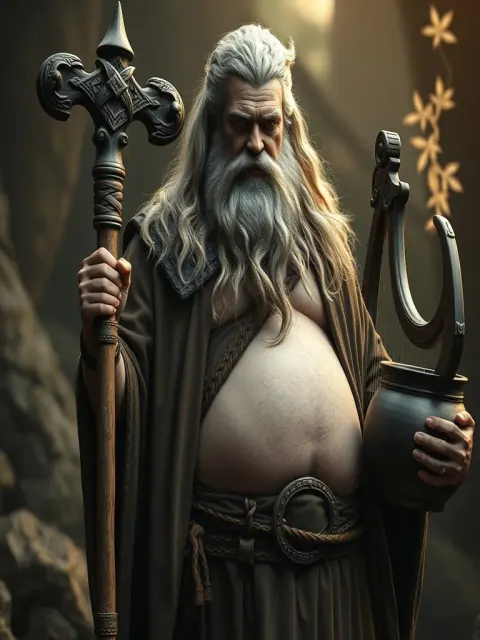
Portrait of Dian Cecht, Celtic deity
Celtic
Tap or drag
Celtic

Dian Cecht

The God of Healing

Domain
Healing & Medicine
Alignment
Lawful Good
Element
Water
Relics of Power
Well of Health
Speak with Dian Cecht

The full Codex

5 sections of this entry are open to everyone: the summary, the people, the symbols, the lineage and the sources. The other 9 (Name and epithets, In the ancient sources, The myths, Worship and archaeology, How the god was depicted, What scholars debate, After antiquity, Did you know?, Codex relic) are part of the full Codex: PRO opens the whole study of all 500 deities, and without a subscription you can read one full entry a day, just like in the app.

The People

People
Celtic peoples
Region
Ireland, Britain & Gaul
Period
c. 500 BC – 500 AD

The Celtic gods were worshipped by the peoples of Ireland, Britain, and Gaul, with the aid of the druids, their priestly caste. They venerated them in sacred groves, springs, and wells, without great stone temples. Many of their myths survived in the Irish and Welsh sagas, recorded by medieval monks.

The Celtic wheel of the year turned on four great fire festivals: Samhain, the origin of Halloween, opened winter and contact with the dead; Imbolc, Beltane, and Lughnasadh marked spring, summer, and the harvest. The druids led the rites in sacred groves called nemeton.


At a glance

Dian Cécht (also spelled Dían Cécht) is the supreme god of medicine, healing surgery, and pharmacological wisdom of the Tuatha Dé Danann in medieval Irish mythological literature. Venerated as the divine founding father of the healing arts among the Gaelic gods, his name is explicitly interpreted in the 9th/10th-century Cormac's Glossary (Sanas Cormaic) as 'dia na legi' ('god of physicians') and glossed in Latin ecclesiastical registers as 'deus salutis' ('god of health and salvation'). Dian Cécht occupies a pivotal role in the saga literature detailing the Battles of Mag Tuired: after the First Battle, in which High King Nuada suffered the loss of his right arm severed by the Fir Bolg warrior Sreng, Dian Cécht combined his anatomical mastery with the metallurgical craftsmanship of Credne to fashion an articulated mechanical prosthesis of solid silver with functioning joints and moving fingers (earning the sovereign the title Nuada Airgetlám, 'Nuada of the Silver Arm'). In the Second Battle of Mag Tuired, Dian Cécht consecrated the miraculous Well of Sláine (Tipra Sláine), into which mortally wounded and mutilated warriors were submerged, emerging completely restored and invigorated to rejoin the battle line. Concurrently, Gaelic tradition depicts him as harboring a jealous intolerance of any rival surgeon: when his younger son Miach surpassed his skill by regenerating living flesh, sinew, and skin onto Nuada's stump, Dian Cécht slew Miach with four strokes of his sword, subsequently scattering the 365 healing herbs that grew from his grave to prevent mortals from acquiring absolute pharmacological mastery over death. His prestige within early Gaelic society was such that an 8th-century Old Irish legal treatise on physician liability, physical injuries, and patient compensation was titled Bretha Déin Chécht ('The Judgments of Dian Cécht').

7 min read · Reviewed on September 29, 2026 · How we research

Sacred symbols

The well of healing, the medicinal herbs, the silver arm and the scalpel

Family

Parents
Esarg mac Néit (ancestral noble of the Tuatha Dé Danann)
Siblings
Dian Cecht
Children
Miach (miraculous physician slain by his father)Airmed (keeper of the three hundred sixty-five healing herbs)Cian (noble father of the celestial champion Lugh Samildánach)Octtriallach / Cethe (ritual assistants at the Well of Sláine)
Genealogy according to Cath Maige Tuired (§ 33, 121–123); Lebor Gabála Érenn (IV.VII); Sanas Cormaic; Bretha Déin Chécht

Sources and further reading

Primary sources

  • Elizabeth Gray (edition of the medieval codex and commentary), Cath Maige Tuired (The Account of Moytura: Nuada's Prosthesis and the Well of Sláine). translation: Irish Texts Society, vol. LII, Naas, 1982. read
  • Daniel A. Binchy (ed. e trad.), Bretha Déin Chécht (The Judgments of Dian Cécht on Physicians). translation: Ériu, volume XX, Royal Irish Academy, Dublin, 1966 (listed in the CELT catalogue). read
  • Whitley Stokes (ed.), Three Irish Glossaries: Cormac's Glossary (Sanas Cormaic, entry Dian Cécht). translation: Williams and Norgate, Londres, 1862 / 1868. read
  • R. A. S. Macalister (transcription of the codices and critical notes), Lebor Gabála Érenn: Book of the Conquests of the Island (Volume IV: Tuatha Dé Danann). translation: Irish Texts Society, Dublin, 1941. read

Studies

  • John Arnott MacCulloch, The Religion of the Ancient Celts (Chapter V: The Gods of the Gaels and Dian Cécht). T. & T. Clark, Edinburgh, 1911. open
  • Proinsias Mac Cana, Celtic Mythology (Dian Cécht and the Medical Conflict of Mag Tuired). Hamlyn, London, 1970. open
  • Dáithí Ó hÓgáin, The Lore of Ireland: Folklore Encyclopedia (Article on the Medicine of Dian Cécht). Boydell & Brewer / Prentice Hall, 1991, 1991. open
  • Charles Squire, Celtic Myth and Legend: Poetry and Romance (The Divine Medicine of the Tuatha Dé Danann). Gresham Publishing, London, 1905. open

Name and epithets

The Old Irish theonym Dian Cécht is a compound noun formed from 'dían', meaning 'swift', 'vehement', or 'rapid', and 'cécht', an archaic lexical term translated by medieval scribes and modern Celticists as 'power', 'fea…

In the ancient sources

Cath Maige Tuired (Saga Narrative on Nuada, Miach and Sláine), 9th–12th centuries CE.. Primary narrative text describing Nuada's silver arm, the tragic slaying of Miach, the scattering of herbs, and the healing waters o…

The myths

The Fashioning of the Silver Arm and Miach's Living Cure. As recorded in the opening recensions of Cath Maige Tuired, King Nuada lost his right arm in combat against the Fir Bolg champion Sreng at Mag Tuired.

Worship and archaeology

In ancient and early medieval Ireland, veneration of Dian Cécht was not centered on classical temple enclosures with statues, but around sacred springs, mineral wells, and pastoral healing sites where traditional physic…

How the god was depicted

In Irish literary description and Celtic artwork, Dian Cécht is envisioned as an imposing elder possessing sharp, scrutinizing eyes and a determined countenance, dressed in the woolen cloaks of the learned druidic order…

What scholars debate

Artificial Reconstruction Versus Organic Regeneration (The Slaying of Miach). Scholars of early Irish myth (such as Proinsias Mac Cana and Dáithí Ó hÓgáin) examine the moral and philosophical implications of Dian Cécht…

After antiquity

Dian Cécht endures in Irish cultural memory as the personification of ancient Gaelic medical heritage. Irish herbalist organizations and historical medical societies trace symbolic lineage to his mythic pharmacy.

Did you know?

The Old Irish legal tract Bretha Déin Chécht explicitly stipulated that any physician guilty of gross surgical malpractice was liable to pay full restitution matching the patient's legal honor-price.

Codex relic

Well of Health. A sacred well whose waters heal wounds and resurrect slain warriors.

The rest of this scroll is sealed

The legends, the myth, the cult and relics are part of the full Codex. You can open 1 full entry for free every day; to open all 500 deities with no limits and no ads, subscribe to Codex PRO.

See Codex PROGet it on Google Play

From the same pantheon

View pantheon